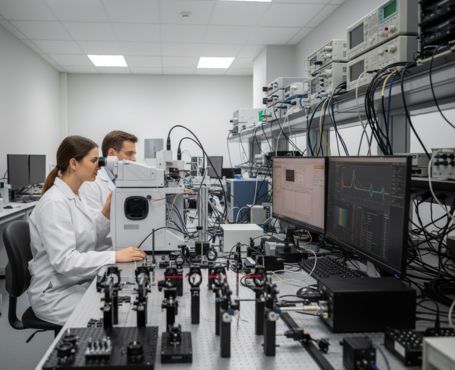
Why Spectroscopy & Photonics
Fiber-based platforms have become standard due to stability, compactness, and immunity to alignment issues compared to bulk lasers. They support long-term operation without frequent adjustments.
Introduction to Fiber Lasers for Spectroscopy
Spectroscopy techniques depend on high signal fidelity and precise wavelength control to examine molecular structures, study chemical interactions or conduct remote sensing. Fiber lasers have become a standard option due to long-term wavelength stability, minimal noise, environmental resistance, efficient thermal performance and reliable long-term operation.
Importance of a Narrow Linewidth Source in Spectroscopy
- High spectral purity
- Better resolution between adjacent spectral lines
- Reduced measurement uncertainty
- Improved detection sensitivity for weak signals
- Increased accuracy in wavelength-based sensing
Core Features of Fiber Lasers for Spectroscopy
Core Features of Fiber Lasers for Spectroscopy — details
1. High Wavelength Stability
2. Low Phase Noise
3. Clean Beam Quality
4. Long Lifetime Operation
5. Consistent Power Output
Applications of Fiber Lasers in Spectroscopy & Photonics
Applications of Fiber Lasers in Spectroscopy & Photonics — details
1. Atomic and Molecular Spectroscopy
2. Raman Spectroscopy
3. Absorption Spectroscopy
4. Laser-Induced Fluorescence
5. Optical Coherence and Interferometric Techniques
6. Photonics Research
7. Remote Sensing
How Fiber Lasers Improve Photonics System Performance
- Reliable performance in extended measurement sessions
- Reduced recalibration requirement
- Better alignment and coupling efficiency
- Strong immunity to external disturbances
- Ideal for compact or portable measurement systems
Technical Characteristics That Matter
- Linewidth specification
- Long-term wavelength stability
- Output power level
- Relative intensity noise
- Beam uniformity and circularity
- Power efficiency and thermal performance
- Optical integration compatibility
- Fiber-coupled or free-space output options
Why Many Institutions Prefer Fiber-Based Narrow Linewidth Sources
- High coherence and spectral purity
- Minimal drift and stable behavior
- Long measurement cycle compatibility
- Durable fiber-based architecture
- Support for advanced photonics experimentation
Fiber Lasers for Industrial Spectroscopy Systems
- Long operational lifetime
- Strong environmental resistance
- High stability under field conditions
- Compact and rugged architecture
- Easy integration into OEM systems
Photonics Development Supported by Spectroscopy Lasers
- Optical coating research
- Integrated waveguide testing
- High-precision spectral systems
- Quantum photonics research
- Laser communication development
Why Choose Fiber Lasers for Research Institutions
- Flexible integration options
- Consistent long-term performance
- Low maintenance requirements
- Stable and repeatable measurement results
Commitment to Reliable Spectroscopy Laser Solutions
Techwin – single frequency fiber laser in Hangzhou City provides reliable fiber-based laser systems engineered for spectroscopy and photonics environments. These systems are developed to maintain stable spectral output, narrow linewidth characteristics and dependable wavelength performance.
Summary
Fiber lasers provide the stability, spectral purity and precision required for spectroscopy and advanced photonics research. Their architecture ensures long operational life, consistent data capture and strong environmental resistance. To request configuration guidance or discuss integration, contact the Hangzhou City support team at +86-571-88284299.
Talk to our experts
Discuss integration, samples & prototyping.
Expert Consultation
Our application engineers are ready to help you select the right product and configuration.
Fast Prototyping
From concept to reality, we accelerate your development cycle with rapid prototyping.
Get in Touch
Fill out the form and we'll respond within 24 hours.