Why Gravitational Wave Detection
Fiber-based platforms have become standard due to stability, compactness, and immunity to alignment issues compared to bulk lasers. They support long-term operation without frequent adjustments.
Introduction to Gravitational Wave Detection
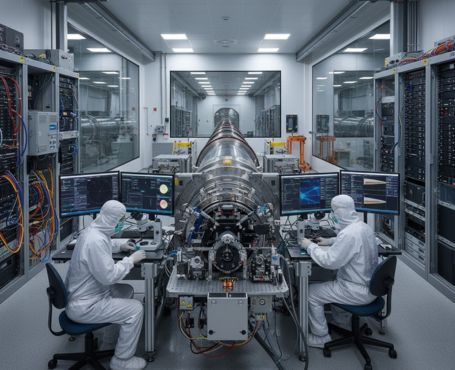
Gravitational waves are ripples in spacetime produced by cosmic events such as merging black holes and neutron stars. Detecting these waves requires large interferometers that can observe variations far smaller than atomic dimensions. Lasers used in these systems must provide stable and predictable output to ensure interferometers function with maximum sensitivity. Key properties include narrow linewidth, strong frequency stability, long coherence length, minimal noise, and excellent beam quality.
Why High-Precision Lasers Are Essential
Why High-Precision Lasers Are Essential — details
Sensitivity to Extremely Small Variations
Frequency Stability for Interferometers
Long-Term Measurement Consistency
Core Requirements for Gravitational Wave Detection Lasers
- Narrow linewidth (sub-kilohertz range)
- Ultra-low intensity noise
- Long coherence length for kilometre-scale interferometers
- Clean TEM00 optical beam profile
- Highly stable frequency output
How Ultra-Stable Fiber Lasers Support Detection Systems
- Noise suppression for clean interferometric detection
- Stability over long optical paths
- Long-term reliability for continuous monitoring
- Seamless integration with reference cavities and modulators
Key Applications in Gravitational Wave Observatories
- Primary input laser source for interferometers
- Laser systems for pre-stabilization stages
- Frequency-locking to reference cavities
- Auxiliary beams for alignment and calibration
- Optical metrology and monitoring systems
Technical Advantages in Gravitational Wave Detection
- High signal-to-noise performance
- Reduced measurement uncertainty
- Stable calibration reference
- Reliable long-term operation
- Accurate interferometric behavior
Features Needed for Gravitational Wave Laser Systems
- Thermal stability
- Vibration isolation
- High-quality control electronics
- Environmental isolation and sealing
Performance Parameters Required
- Sub-kilohertz linewidth
- Very low amplitude noise
- Long coherence length
- Stable output power
- High frequency stability
Role in Advanced Research Facilities
Future gravitational wave facilities aim for higher sensitivity, making the demand for highly stable lasers more important. Ultra-stable fiber laser technology is suitable for next-generation observatories and optical metrology systems.
Benefits for Research Teams and Institutions
- Reliable scientific readings
- Reduced maintenance requirements
- Consistent long-term performance
- Smooth optical subsystem integration
- Improved interferometric stability
Other Fields Using Similar Laser Technology
- Quantum optics
- Metrology
- Optical frequency control
- Precision spectroscopy
- Optical clock systems
Summary
Gravitational wave detection requires lasers with minimal noise, narrow linewidth, and stable long-term operation. Advanced ultra-stable fiber lasers form the foundation of modern interferometric detection systems that enable accurate observation of distant cosmic events.
Talk to our experts
Discuss integration, samples & prototyping.
Expert Consultation
Our application engineers are ready to help you select the right product and configuration.
Fast Prototyping
From concept to reality, we accelerate your development cycle with rapid prototyping.
Get in Touch
Fill out the form and we'll respond within 24 hours.