
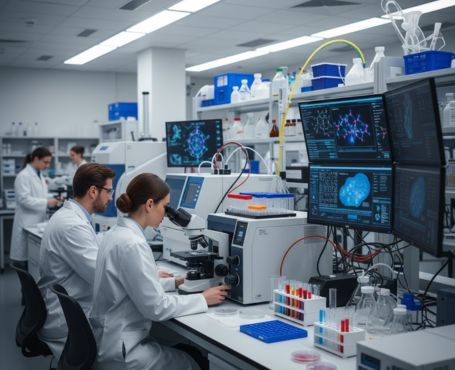
Why Biomedical & Diagnostics
Fiber-based platforms have become standard due to stability, compactness, and immunity to alignment issues compared to bulk lasers. They support long-term operation without frequent adjustments.
Lasers for Biomedical – Reliable Optical Sources for Clinical & Laboratory Use
Healthcare today depends on technologies that support precision, accuracy and stable performance. A biomedical laser plays an important role in diagnostics, imaging, clinical treatment devices and scientific research tools. These optical systems help medical and laboratory professionals carry out tasks that require controlled wavelengths, clean beam profiles and long-term stability. A medical laser is also essential for applications where light interacts with tissue, cells or biological samples with a high degree of control. From non-invasive scanning equipment to therapeutic devices, optical solutions contribute significantly to the quality and consistency of clinical results. This page explains how lasers support biomedical and diagnostic applications, the key performance characteristics required, and why optical systems are widely used in hospitals, laboratories and life-science facilities.
Introduction to Biomedical Laser Technology
A biomedical laser offers a narrow linewidth, stable output and controlled wavelength, making it suitable for medical instruments that operate in sensitive environments. This includes systems used for patient screening, cell imaging, sample analysis, surgical guidance and various research applications. Biomedical equipment developers rely on lasers because clinical devices must deliver consistent performance every time. Any variation in the light source could affect diagnostic accuracy or image clarity, making a stable and dependable system mandatory.
Why Lasers Are Important in Medical and Diagnostic Equipment
Medical procedures and laboratory tests require high precision. A medical laser supports these needs by providing clean, stable and well-controlled optical output that integrates reliably into clinical and analytical systems.
- Clean and stable optical output
- Reliable wavelength stability
- Low noise operation
- Excellent beam quality
- Compatibility with medical and laboratory devices
Major Applications in Biomedical & Diagnostic Fields
The use of lasers in biomedical engineering covers a wide range of devices and instruments. Below are key areas where their importance is significant.
Major Applications in Biomedical & Diagnostic Fields — details
Clinical Diagnostics
Cell Imaging & Advanced Microscopy
Optical Coherence Tomography (OCT)
Therapeutic & Treatment Devices
Biomedical Spectroscopy
Medical Imaging & Scanning Systems
Performance Benefits of Biomedical Laser Systems
Biomedical and diagnostic devices require dependable performance under strict clinical conditions. Purpose-built laser systems provide several key advantages for instrument designers and healthcare providers.
Performance Benefits of Biomedical Laser Systems — details
1. Long-Term Stability
2. Superior Beam Quality
3. Low Noise Characteristics
4. Efficient Integration
5. Strong Reliability
Industries & Medical Sectors Using Biomedical Lasers
Biomedical laser technology is used in a wide range of medical and research environments to support diagnostics, imaging, treatment and scientific studies.
- Hospitals
- Pathology labs
- Research institutes
- Biotechnology companies
- Pharmaceutical labs
- Ophthalmology clinics
- Dermatology centers
- University medical departments
- Medical device manufacturing companies
Biomedical Fields Supported by Laser Technology
Biomedical Fields Supported by Laser Technology — details
Ophthalmology
Dermatology
Genomics
Oncology
Neurology
Technical Considerations for Medical Laser Integration
To ensure compatibility with biomedical equipment, developers evaluate optical, mechanical and control parameters that affect device performance and safety.
- Appropriate wavelength selection
- Output power levels
- Thermal stability
- Noise performance
- Beam quality
- Modulation or control requirements
- Integration size and structure
Customization Options for Biomedical Applications
Manufacturers offer customization options to match specific device and application requirements, supporting OEM integration and product differentiation.
- Custom wavelengths
- Power configuration options
- OEM module design
- Control interfaces
- Mechanical design adjustments
About the Brand
Techwin – single frequency fiber laser in Hangzhou City provides optical solutions that support laboratory research, clinical diagnostics and biomedical equipment development. The brand is known for systems designed to maintain precision and consistency in sensitive environments. A biomedical laser is central to modern diagnostics, imaging technology, research applications and treatment devices. Its role spans from clinical laboratories to operating rooms, supporting the accuracy required for medical assessments. A medical laser ensures dependable performance by delivering controlled optical output, narrow linewidth and stable wavelength. As biomedical engineering advances, lasers continue to support high-quality instruments used in patient evaluation, sample analysis and scientific research.
Talk to our experts
Discuss integration, samples & prototyping.
Expert Consultation
Our application engineers are ready to help you select the right product and configuration.
Fast Prototyping
From concept to reality, we accelerate your development cycle with rapid prototyping.
Get in Touch
Fill out the form and we'll respond within 24 hours.